Trilhas da Cena

English

Rita Aquino

Rita Aquino is a dance artist and researcher. She is the co-director of the Festival Internacional de Artes Cênicas da Bahia (FIAC Bahia) (Bahia International Performing Arts Festival), where she focuses on curatorship and the festival’s training, mediation, and accessibility activities. A professor at the Escola de Dança da Universidade Federal da Bahia (UFBA School of Dance) teaching at both undergraduate and graduate levels, she is currently the Arts and Culture Coordinator at the university’s Pró-Reitoria de Extensão, Arte e Cultura (Office of the Pro-Rector for Extension, Arts, and Culture).

Rita Aquino Read More »

A Panacéia

A Panacéia (Panacéia Theatre Collective) is a theatre collective founded in 2008 in Salvador that brings together women and creates repertoire engaged with feminist proposals. With a focus on original dramaturgy and research on historical women, it operates locally, nationally, and internationally through performances, formative workshops, and collaborative networks of Latin American artists.

A Panacéia Read More »

Dembwa

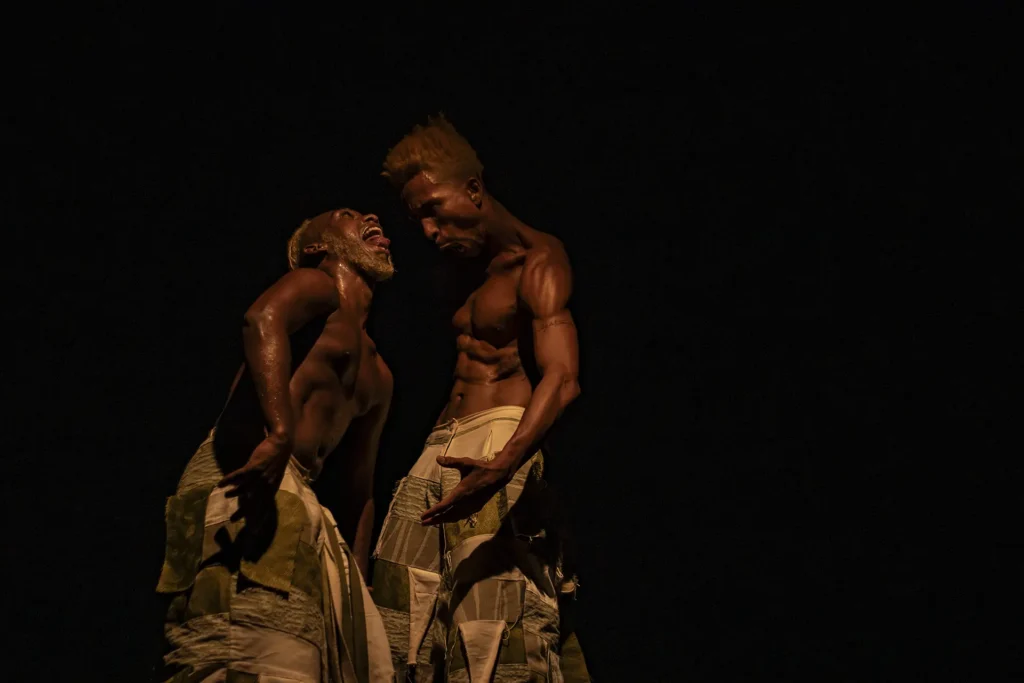
Dembwa is a danced journey performed by Marcos Ferreira and Ruan Wills that interweaves body and memory to reactivate ancestral knowledge. The work understands ginga as technology: a gesture that deflects, creates, and resists. Between samba de caboclo and funk, the performance revisits roots that pulse in memory. Dembwa invites the audience to recognize, in dance, the continuity of a living heritage that projects itself in the present as future.

Dembwa Read More »

Ana e Tadeu

Ana and Tadeu have been married for fifteen years and have a son, the boy Jorge. Urban violence sets off a chain of events that irreversibly changes the lives and subjectivities of these characters. With the marriage in ruins, Tadeu returns to collect his belongings and move out. However, he finds the house caught in a crossfire. Confined, Ana and Tadeu smooth over the last rough edges of a relationship hemmed in by affection, pain, and the very violence that cuts through and constrains them.

Ana e Tadeu Read More »

Cia Única de Teatro

Cia. ÚNICA de Teatro was conceived in 2018 by Júnior Dias and Júlia Lorrana, a period during which the group began its research, development, and staging work. In December 2019, it debuted with the sketch “Joca e os Brinquedos” (Joca and the Toys) and has since continued its activities. In 2021, Cia. ÚNICA launched its new production, “A Aventura de Joca” (Joca’s Adventure), virtually on its YouTube channel, alongside the documentary series “Por Trás das Cortinas” (Behind the Curtains), which documented the staging process and reached over 1,000 people across all audiences.

In 2024, the Company premiered its most recent production, “Akoko Lati Wa Ni – Tempo de Ser” (Akoko Lati Wa Ni – Time to Be), which was developed through collaborative workshops for performers and art-makers, in partnership with TPC – Teatro Preto de Candomblé and Oyá L’ade Inan Ponto de Cultura.

Cia Única de Teatro Read More »

FIAC Bahia

FIAC Bahia was born in 2008 and, since then, has held 15 editions, establishing itself as a laboratory for innovation in the performing arts. Its proposal has a rhythm that permeates the very act of artistic creation; it evokes other forms of knowledge at the street corners of the city and its spaces, on the

FIAC Bahia Read More »

Foto: Renato Mangolin

My-body-is-here

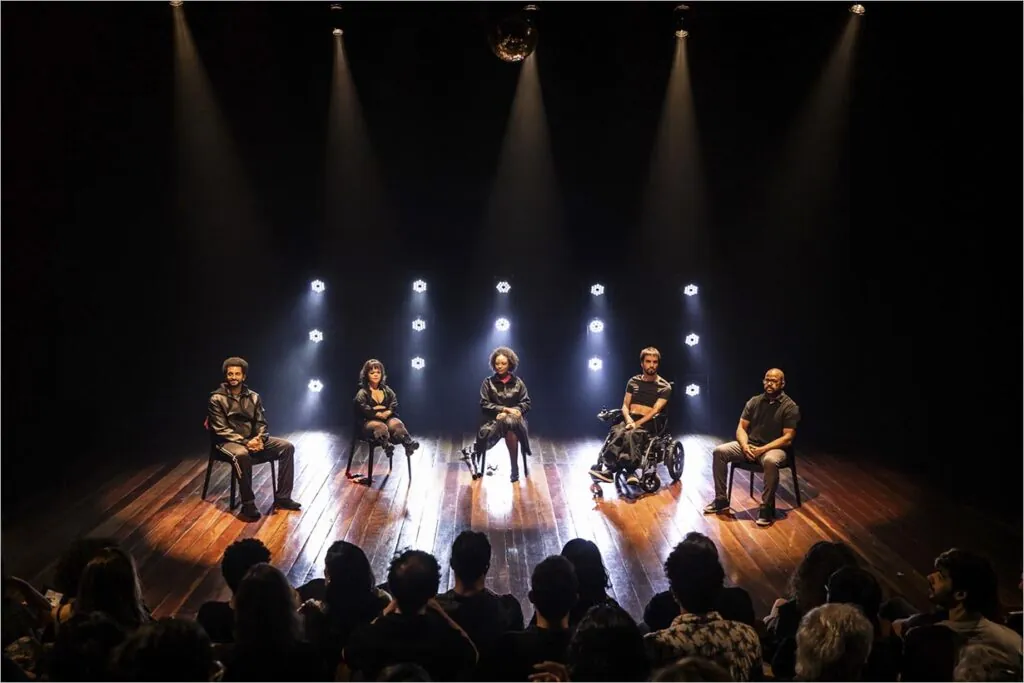
“My Body Is Here” is a theater performance featuring actors with disabilities openly talking about their relationships, bodies, and desires, based on their personal experiences.
The cast includes Bruno Ramos, who is deaf-mute, Haonê Thinar, with an amputation, Juliana Caldas, who has dwarfism, Pedro Fernandes, who has cerebral palsy with preserved cognitive ability and is a wheelchair user, and Jadson Abrãao, an actor and sign language interpreter.
Directing and playwriting are Julia Spadaccini, who is speaking deaf, and Clara Kutner.
The play “My Body Is Here” brings an original theme: affection and sexuality in bodies with disabilities. It is an unprecedented theme on stage and dives into reflecting on these bodies that are “marginal”, silenced, and socially denied. The body of a person with a disability is rarely explored as an object of love or sex, whether on stage, on TV, or in the movies.
Theater needs to do its part!

My-body-is-here Read More »