
A Panacéia - grupA Theatre Group
City: Salvador
State: Bahia
Founded: 2008
Page updated on December 4th, 2025.
Note: The term “grupA” maintains the original Portuguese spelling, an intentional choice by the collective as a feminist affirmation. In Portuguese, the “-A” ending generically marks the feminine, and the collective uses this spelling to reaffirm its identity as a group constituted exclusively by women.
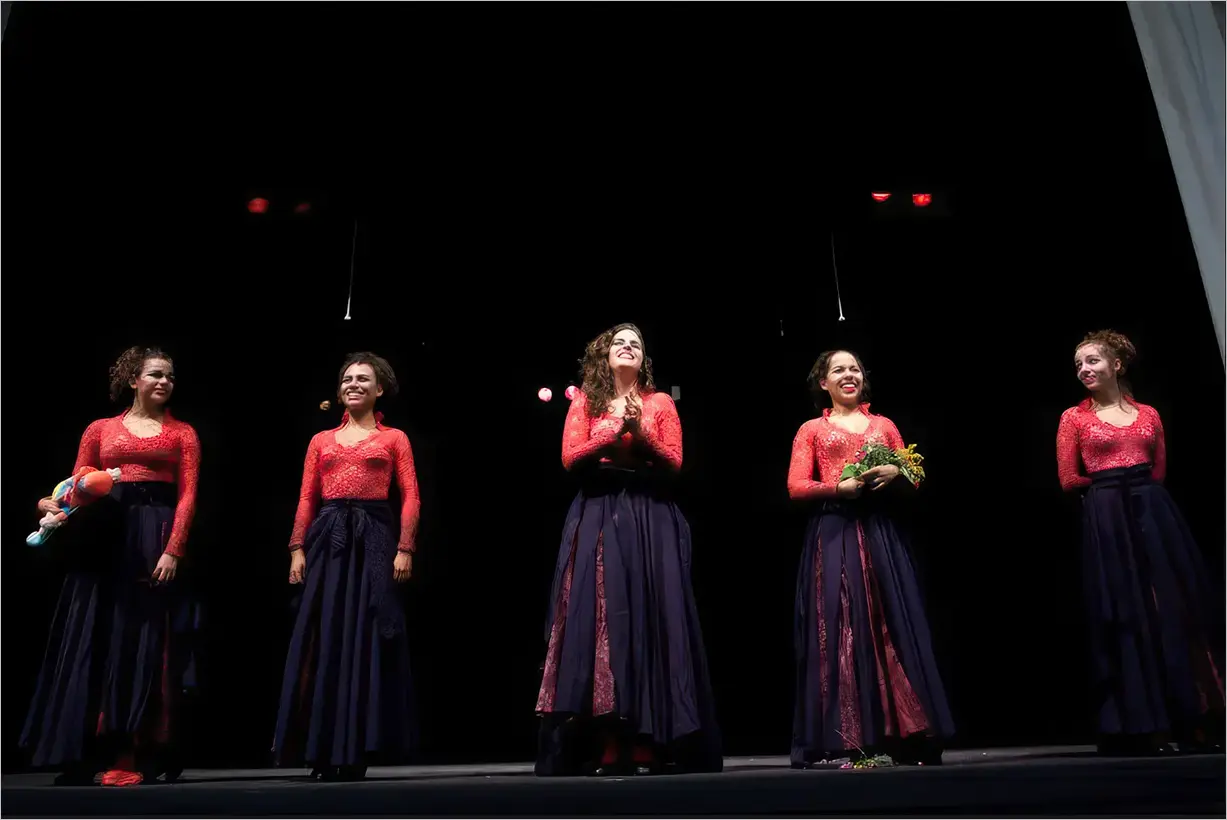
Founded in 2008 in Salvador/BA, A Panacéia exists as a grupA Theatre Group that brings together women in its work teams and creates repertoire engaged with feminist proposals and the visibility of historical women. Created as a collective of actresses, we work with guest directors for each new production and characterize ourselves as a space of investigation that starts from the conception of projects to the development of text and scene. From its second performance, the grupA decided to invest in dramaturgy research and in forms of collective creation, moving toward the writing of its own texts. Since then, we have always worked with original repertoire.
A Panacéia has circulated locally, nationally, and internationally, and was part of the founding and management of Colectivo Âmbar, a network of Latin American artists, working in its formative activities, creation through international co-production, and in the creation of the network’s festival, FITLÂ. We are particularly interested in exchanges and contact with other Latin American countries. We articulate ourselves through networks and currently integrate the Professional Theatre Movement of Bahia (Movimento Teatro Profissional da Bahia) and Rede Pavio (Network of Research Theatre Groups and Continuous Actions of the Northeast). In recent years, A Panacéia has deepened its research on women from History, an investigation that guides our latest artistic productions. Still aligned with this direction, A Panacéia‘s formative activities are directed toward women and girls through theatre courses and workshops that promote proprioception, group work, and the investigation of trajectories of women from History as a path toward social transformation and the achievement of gender equity.
History
In 2010, A Panacéia premiered its 1st performance, a production of Dorotéia, a text by Nelson Rodrigues and directed by Hebe Alves. The play won the Myriam Muniz Production Award, circulated throughout the state of Bahia, throughout Brazil, and was part of the Verano Malayerba showcase (Ecuador, 2013), in addition to being awarded the “Innovation and Creativity Award” from the TeatranlyKoufar festival in Minsk, Belarus, and was selected for the Funarte festival that celebrated the centenary of Nelson Rodrigues, with presentations at Teatro Dulcina (RJ).
From 2011 onwards, the grupA developed its original trajectory with the performance Lua Caída (2013) and the performances Lua Crescente (2013), whose text was selected for Women Playwrights International in Cape Town, South Africa. Lua Cheia (2015) premiered at the second edition of the Festival Itinerante de Teatro Latinoamericano Âmbar and Nenhuma Carta (2016) went through local and national festivals.
From 2019 onwards, A Panacéia consolidated its focus on research about women from History with EU PAGU (2019). In 2024, Filipa, directed by Elisa Mendes, was awarded the 12th Ordem do Mérito Cultural da Diversidade LGBT+ Award from Grupo Gay da Bahia, by bringing the trajectory of Filipa de Souza, a sapphic woman who faced the Inquisition.
Complementing this line of research, the children’s performances 200+1 – As Heroínas da Independência (200+1 – The Heroines of Independence) and Meninas Contam a Independência (Girls Tell Independence) bring these stories closer to children and adolescent audiences, retelling Brazil’s independence from the perspective of the heroines who led popular struggle in Bahia.
Meninas Contam a Independência
(Girls Tell Independence)
Children's performance in repertoire
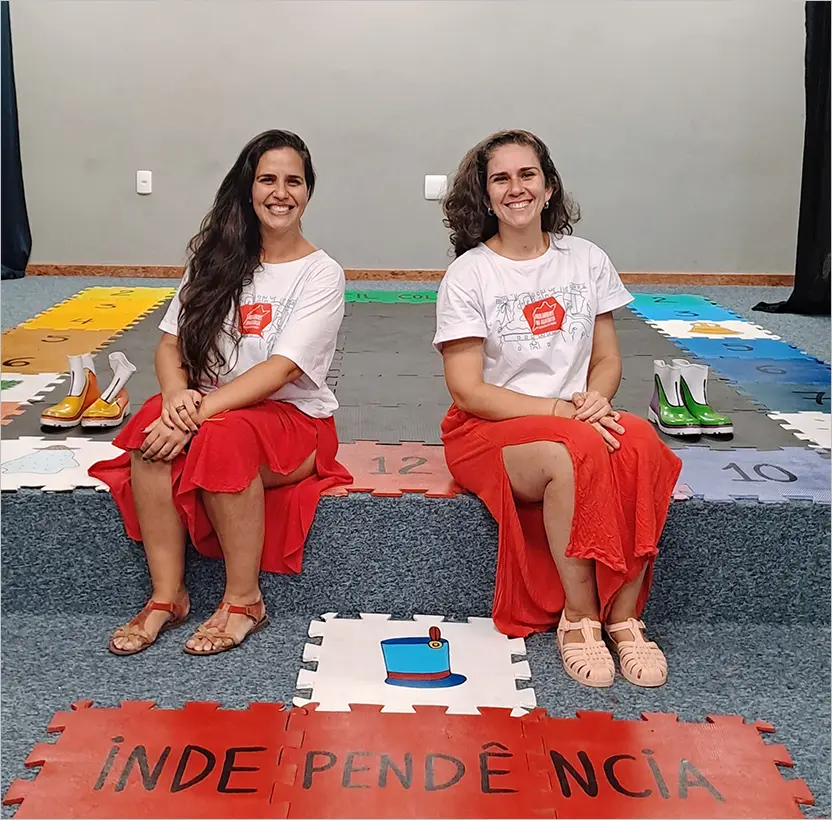
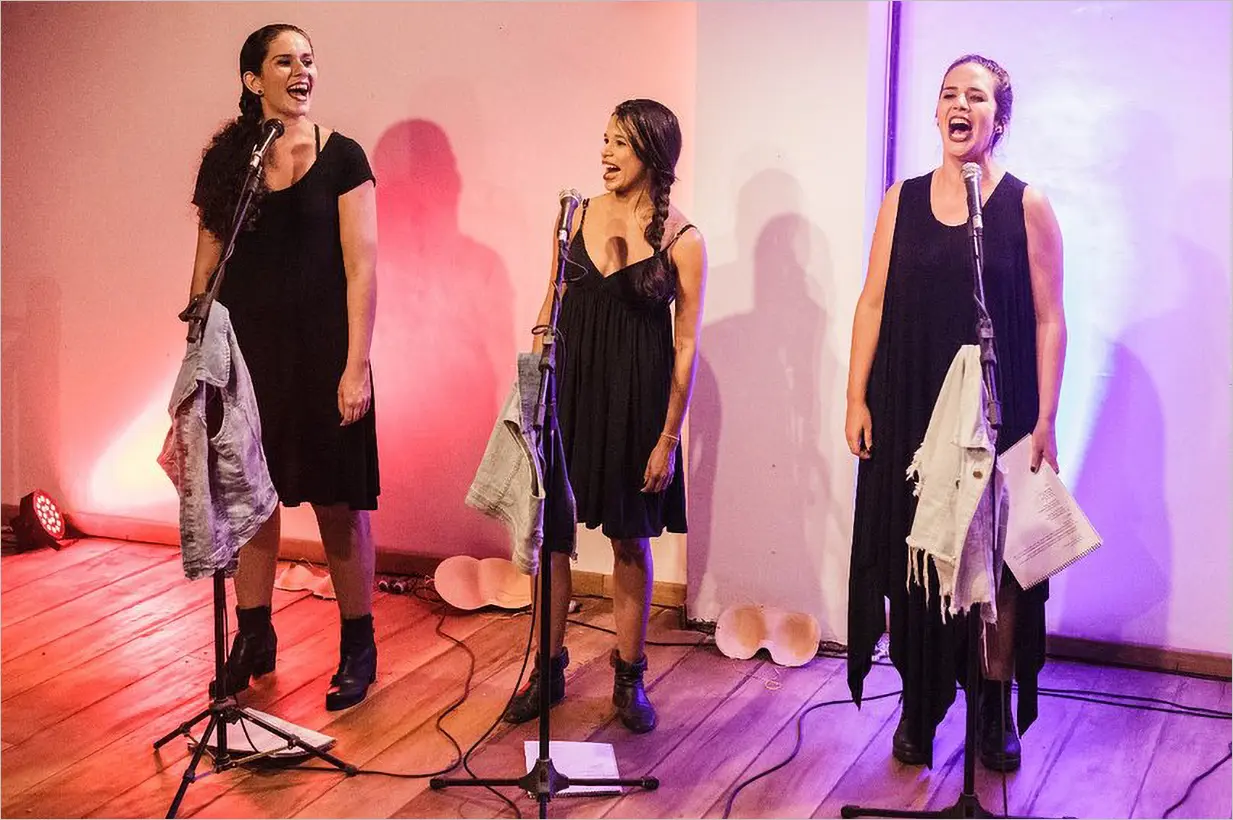
Two actresses discover a mysterious board game and embark on a fun journey toward rescuing the memory of women in the country’s history. Meninas Contam a Independência is a “play-game,” a playful, interactive, and unpredictable performance like every board game. The only certainty is that by the end of the game, many stories will be unveiled about the heroines of Brazil’s Independence in Bahia. Characters such as Joana Angélica, Maria Felipa, Maria Quitéria, and Urânia Vanério are part of the stories, challenges, and enigmas of this game. Meninas Contam a Independência is the new work by the theatre grupA A Panacéia, which has text written by the grupA’s members, directed by Lara Couto, and featuring guest actress Márcia Limma in the cast. The performance is the result of years of research about and with childhoods and regarding women from History: since 2020, Ana Luisa Fidalgo and Camila Guilera have conducted theatre workshops with girls (from age 6), adolescents, and women, always under the motto of “to scenically explore stories of incredible women!”
The play had an itinerant premiere season in December 2024, passing through schools, public health spaces, and institutions serving child audiences. In 2025, it had brief seasons at Cine Teatro 2 de Julho and Teatro Sesi Rio Vermelho, in addition to a presentation by invitation from Sesc Senac Pelourinho, as well as performances at FIGA and FIAC festivals (BA) and the Northeast Theatre Festival of Guaramiranga (CE). Meninas Contam a Independência was nominated as the best children’s and youth performance of 2024 at the Prêmio Bahia Aplaude.
Technical and Artistic Credits
Conception and Realization: A Panacéia
Special Participation: Marina Fidalgo (voice-over of the girl Urânia)
Original Soundtrack: Carla Suzart and Neila Kadhí
Arrangements: Carla Suzart and Neila Kadhí
Production: Camila Guilera
Download the performance portfolio in PDF by clicking here
FILIPA (Filipa)
Adult performance in repertoire
Filipa brings to the stage the singular and captivating trajectory of Filipa de Souza, a historical figure condemned in the late sixteenth century by the Visitation of the Portuguese Inquisition that arrived in Bahia, Brazil, under the accusation of “sodomy.” Filipa, according to historical documentation, acknowledges that she had affective and sexual relationships with various women and bears the consequences of her courage. In the staging, the character, upon revisiting her period between imprisonment, sentence of humiliation, public lashing, and banishment, makes a digression about her own life and argues that she has nothing to repent of, knowing that desire made her life possible, as a woman who, being free in thought and soul, sought “the deep taste of life.”
Filipa is a monologue by Camila Guilera directed by Elisa Mendes and original text written in partnership by both, with original soundtrack signed by Carla Suzart and Neila Kadhí, in addition to a team composed exclusively of women.
The performance had its premiere in Salvador/BA, Brazil in May 2024 and has already passed through more than six theaters in the city, in addition to presenting itself in the interior of the state and participating in the 30th Nordeste Theatre Festival of Guaramiranga in Ceará. Filipa, still in 2024, received the 12th Ordem do Mérito Cultural da Diversidade LGBT+ Award from Grupo Gay da Bahia, an organization of national recognition, for its work of registering that homoaffectivity has always existed and has always been persecuted, making us look to the past to transform the present.
Technical and Artistic Credits
Actress: Camila Guilera
Direction: Elisa Mendes
Filipa (Filipa) - Second Movement
The creative process for the Filipa performance occurred during the pandemic period. Faced with the possibilities, we began the creative investigation through video experiments.
MENINAS PODEM (Girls Can) and NÓS! (We!)
Workshops
Composing the formative axis of the grupA’s activities, the MENINAS PODEM (Girls Can) project comprises the conception, research, development of pedagogical material, documentation, reflection, and the realization of theatre workshops for girls and women under the motto of “investigating stories of incredible women.”
Since 2011, A Panacéia has worked with formative activities directed exclusively toward women (all people who identify themselves as such), through theatre workshops that promote proprioception, collective articulation, and that create safe spaces for free expression and for the narration of their own stories. From 2020 onwards, we began working with childhoods, in workshops and courses (online or in-person, with duration of one shift, one month, or one year) directed toward girls from age 6.
A theatre workshop to investigate stories of real women: those who made History and we often do not know existed and also our aunts, grandmothers, mothers… A space of discovery, debate, and creation, based on storytelling, games, and other dynamics. The workshop is conducted by the actresses from the theatre grupA A Panacéia: Ana Luisa Fidalgo (who is also a psychologist with training in clinical practice with children) and Camila Guilera (educator with more than a decade of experience working with children from Early Childhood Education and Elementary School I).
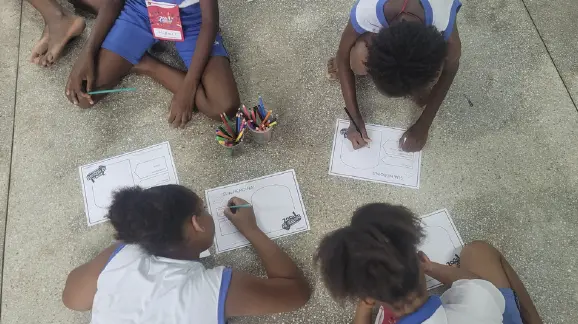
The focus of the workshops for childhood is on the creation and narration of stories, on stimulating curiosity and the desire for research around stories of women, as well as on group work for scene creation. The members of A Panacéia develop games and didactic materials specific to working with this age group. The NÓS! (We!) version is directed toward adolescents and women, based on the same investigative principles and the search for a safe space of free expression.
MIL E UMA FORMAS DE MATAR UMA MULHER
(A Thousand and One Ways to Kill a Woman)
Ongoing project
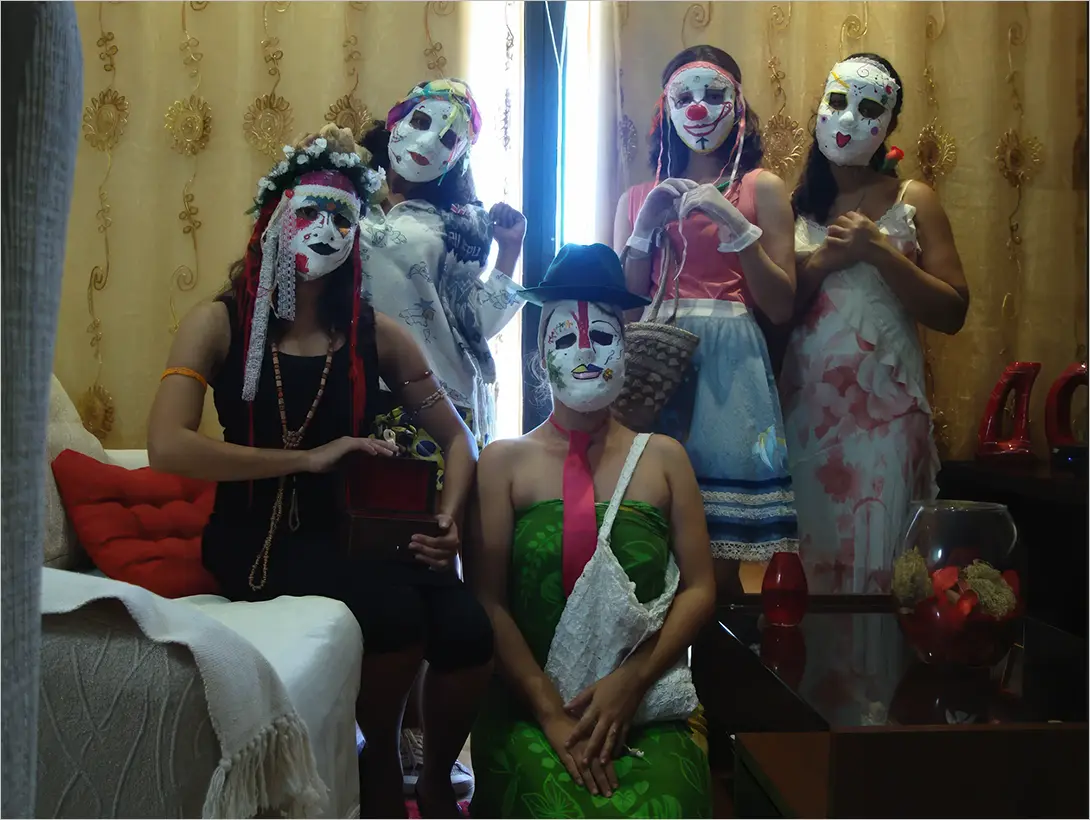
This is the ongoing project by A Panacéia for its new production. Mil e Uma Formas de Matar uma Mulher is an adult piece that proposes itself as an investigative game to be played — and created — with the audience present. The clues of a supposed crime will be drawn each night: the location, the weapon, the time, the motivation. The actresses on stage, then, will improvise “stories to not die today.” The atmosphere of play, of a board game, serves as a shield against the density of the theme: femicide. The use of exaggeration, of the grotesque, and of caricature as scenic devices will expose the absurdity of a type of everyday crime: every 17 hours a woman is murdered in Brazil simply because she is a woman.
The performance is sustained by three lines of force: biographical narrative, journalistic language, and theatrical improvisation. The first layer mentioned is an axis that dialogues with the ongoing research by A Panacéia: historical characters on stage, the presence of stories of women whose trajectories were erased by official History. In Mil e Uma Formas de Matar uma Mulher, we will tell the life of Maria da Penha, who escaped death at the hands of her husband and who, in her struggle for justice, went to international courts so that gender violence would be classified in Brazilian legislation.
The second line of force, journalistic language, is the one that will feed the game clues with updated data. Unfortunately, material does not lack: each day we have so many new cases of murdered women. Finally, the third axis comprises improvisation — no session of the performance will be the same as another. Each night, we will improvise the story of how to kill a woman and we will seek, together with the audience, to subvert this plot.



QUER TER PÁGINAS NO TRILHAS DA CENA?